
Reverse Face Search Guide for Public Photo Checks
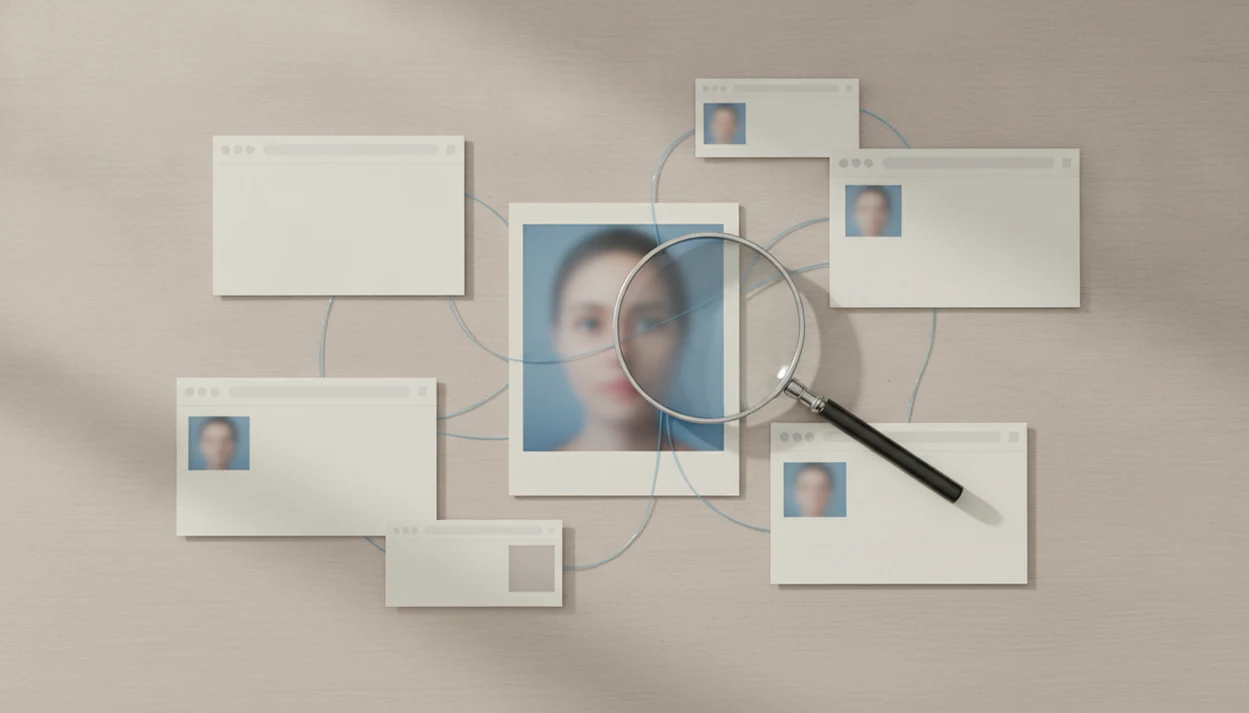
A reverse face search guide shows you how to check whether a face photo appears elsewhere online, compare likely matches, and treat every result as a clue rather than proof. Use public face search for verification, scam-photo checks, and your own privacy audits, not for stalking, doxxing, or sensitive decisions.
> Definition: Reverse face search is the process of uploading or searching a face photo to find visually similar or matching faces in publicly indexed online images.
- Reverse face search can surface public profiles, reused scam photos, and lookalike images, but it cannot search private accounts or closed databases.
- The best workflow uses a clear face crop, multiple tools, ordinary reverse image search, and context checks before drawing conclusions.
- A match is evidence to investigate, not proof of identity, intent, relationship status, employment, or wrongdoing.
Reverse Face Search Guide Definition for Public Photo Checks
Reverse face search is the process of using a face photo to look for visually similar or matching faces in publicly available online images. A reverse face search guide helps you run that check carefully, then read the result as a public-web clue, not a confirmed identity.
People use it for dating-photo checks, marketplace-photo checks, finding where their own photos appear, and spotting reused images in suspicious profiles. We often start by opening three browser tabs: the original profile, the search result, and the platform help page. That keeps the source trail visible.
Face Search App publishes cautious public-photo workflows for finding people by photo, reverse face search, social profile lookup, and scam-photo checks. Use it to structure evidence review, not to produce guaranteed identity verdicts.
5 Reverse Face Search Facts Before Uploading a Photo
Before uploading any image, treat reverse face search as a limited public-photo check. These five facts prevent most unsafe conclusions.
- Clear faces work better: A front-facing, well-lit image usually gives cleaner results than a tilted, filtered, or shadowed photo. - No tool sees everything: No engine searches every face on the internet, even if the upload screen sounds confident. - Private spaces stay mostly out of reach: Private accounts, closed groups, messages, and non-indexed databases are usually not searchable. - Multiple tools reduce blind spots: A result in one engine may disappear in another, so compare face search with ordinary reverse image search. For comparison, test specialized public face tools such as PimEyes or FaceCheck.ID alongside broader image tools such as Google Lens. - Consent and rules matter: Privacy, platform policy, and local law should shape whether you search at all.
On a rainy bus ride checking a new match, the fastest mistake is trusting the first similar face. Slow down. Public face search is a lead generator, not an identity system.
Reverse Face Search Algorithms Behind Public Results
Reverse face search works by detecting a face in an uploaded image, extracting measurable features, turning those features into a facial embedding, and comparing that embedding with indexed public images. In plain terms, the tool converts the face into a searchable pattern, then ranks visually similar results.
That is different from one-to-one verification, where a system checks whether two controlled images show the same person. Open-web public search is messier because source coverage, image age, compression, pose, and crawling access vary by tool. The familiar mismatch is a glossy profile portrait beside a low-resolution repost on an old public page.
NIST testing reported false negative identification rates below 0.3% for the most accurate algorithms in one-to-one verification under ideal conditions, but lower-quality images raised errors source. Public web photos are rarely ideal. For public checks, image quality and source coverage usually matter as much as the algorithm.
5 Steps to Use Reverse Face Search Safely
Use reverse face search as a documented, privacy-aware workflow. The safest process preserves context and avoids acting on one result.
1. Choose the clearest face photo
- Choose the clearest available image with a visible face, steady lighting, and minimal blur.
- Crop the photo to the face, but keep useful context when clothing, signage, or background may help.
- Remove unnecessary metadata when possible, especially if the file came from your own camera roll.
- Search more than one public face search or reverse image search tool to reduce single-engine gaps.
- Save URLs, dates, and page context, not just screenshots.
- Avoid contacting, accusing, or exposing anyone based only on a search result.
2. Crop the image carefully
Crop obvious distractions, then keep one uncropped copy for context. The reverse image search vs face search distinction matters because logos, rooms, and captions can sometimes find the source faster than the face.
3. Search multiple public tools
If a trial timer is ticking above an upload box, don’t rush into paying before testing a lower-risk option. A free reverse face lookup can be enough for an initial public-source check.
4. Compare matches and page context
Open results in separate tabs, then compare source pages before deciding what the result shows.
5. Document clues without escalating
Save dated screenshots and URLs, then corroborate before acting.
Public Face Search Photo Requirements Before Upload
Public face search needs a usable image and a cautious upload habit. Low-quality inputs increase both false positives and missed matches because the tool has fewer reliable face details to compare.
- Resolution: Use the highest-resolution version available. Blocky compression can turn eyes, jawlines, and skin texture into guesswork.
- Lighting: Even light beats harsh shadows. A hospital bed photo sent after midnight, for example, may need extra caution before any search result is trusted.
- Angle and occlusion: Front-facing images work better than side profiles, masks, sunglasses, or half-hidden faces in car selfies.
- Filters and edits: Beauty filters, face swaps, stickers, and heavy sharpening can distort the comparison.
- Context: A full image may beat a tight crop when the background, watermark, or caption can help trace the original source.
Check permission prompts before uploading. If an app asks for full camera roll access, choose limited access when your device allows it.
Reverse Face Search Result Interpretation Checklist
A reverse face search result should be graded by image similarity and page context, not by rank alone. Identical image matches are stronger clues than similar-face matches, but neither proves identity by itself.
| Result signal | What to compare | How to treat it |
|---|---|---|
| Strong clue | Same image, same crop, matching page date, consistent profile context | Investigate the source trail and save URLs |
| Weak clue | Similar face, different age, pose, lighting, or edited crop | Treat as a possible lookalike |
| No useful result | No match, broken page, unrelated faces, or vague thumbnails | Do not assume the photo is fake |
| Context conflict | Same face appears under different names or claims | Corroborate with dates, captions, and platform history |
| Partial match | Cropped copy, repost, meme page, or compressed duplicate | Check the original context before drawing conclusions |
For scam-photo checks, romance scammer photo search workflows should combine face results with message patterns, payment requests, and profile age. A matching photo is a risk signal, not a verdict.
4 Common Reverse Face Search Myths
Can one photo reliably identify anyone? No. Reverse face search can suggest public matches, but a single photo can also return lookalikes, old reposts, and unrelated people with similar features.
Can tools see private social media accounts or messages? Public tools generally cannot search private profiles, encrypted chats, closed groups, or databases they are not allowed to access. No result may simply mean the image is not indexed.
Does every tool perform the same? No. Index size, face detection quality, ranking logic, and source access vary widely. A 2019 NIST study found many algorithms had demographic differentials in false positives by factors of 10 to 100 across demographic groups source.
Does a top result prove identity? Also no. For everyday users, comparing source context is often safer than trusting visual similarity because names, dates, and upload history reveal contradictions that the face match cannot.
Common Reverse Face Search Mistakes to Avoid
The most common reverse face search mistakes come from moving faster than the evidence. A similar face, a blank result, or a dramatic caption should slow the check down, not end it.
- Verify dates, captions, page titles, and source URLs before trusting a visually similar match. A repost from 2018 and a fresh dating profile may tell very different stories.
- Review consent, privacy expectations, and platform rules before uploading private, sensitive, or intimate photos. If the image was not yours to share, pause.
- Keep one uncropped copy beside the face crop. Background signs, watermarks, uniforms, room details, or an old caption can identify the original page faster than the face.
- Treat no result as inconclusive. The image may be private, new, blocked from indexing, altered, or simply absent from that tool’s public sources.
- Corroborate public-web evidence before contacting, accusing, reporting, or exposing anyone. Save URLs and context first, then look for independent signals that support the same conclusion.
The safe habit is boring: compare, document, wait, and only act when the source trail holds together.
Limitations
Reverse face search has real limits, and those limits matter before you act. Treat every result as a possible match, not proof.
- It cannot guarantee identification from a single image.
- Coverage depends on each tool’s index, public source access, and update schedule.
- Private profiles, deleted pages, closed groups, and encrypted messages are not generally searchable.
- Lighting, angle, age changes, filters, compression, masks, and glasses can reduce reliability.
- Lookalikes and demographic performance differences can create false positives.
- Search results do not verify job, income, location, relationship status, intent, or criminal behavior.
- Using public face search for surveillance, employment screening, harassment, discrimination, or doxxing can be illegal or against platform rules.
- Pew Research Center reported that only 36% of U.S. adults were very or somewhat familiar with facial recognition, and trust in technology companies was much lower than trust in law enforcement source.
- The EU AI Act restricts real-time remote biometric identification in publicly accessible spaces for law enforcement in most circumstances, showing serious regulatory concern source.
Hands pulled back from the send button is the right instinct. Corroborate first.
FAQ
What is reverse face search?
Reverse face search uses a face photo to find visually similar or matching faces in publicly indexed online images. Ordinary image search may focus more on the whole picture, objects, text, or page context.
How accurate is reverse face search?
Accuracy varies by image quality, tool coverage, algorithm performance, and whether the matching image is publicly indexed. Results should be treated as clues, not identity proof.
Can reverse face search identify anyone?
No. Reverse face search can suggest public matches, but it cannot reliably identify every person or search every image online.
Can reverse face search check private profiles?
Public tools generally cannot access private accounts, direct messages, closed groups, or encrypted conversations. They are limited to public or otherwise indexed sources.
What photo works best for reverse face search?
A clear, well-lit, front-facing photo without heavy filters, blur, masks, or sunglasses usually works best. Keep a context copy if the background or caption may help verify the source.
Does no reverse face search result mean a photo is fake?
No. No result may mean the image is private, new, deleted, blocked from indexing, or absent from that tool’s sources.
Is reverse face search legal?
Legality depends on location, purpose, consent, data protection rules, and platform terms. Do not use Face Search App or any public face search tool for harassment, doxxing, discrimination, or covert surveillance.
Can scammers reuse face photos?
Yes. Scammers can reuse public photos from profiles, old pages, model portfolios, or stolen posts. Verify matches with URLs, dates, message behavior, and other risk signals.
How should I verify reverse face search matches?
Compare URLs, page dates, captions, profile consistency, image crops, and results from multiple tools. Face Search App can help structure the review, but the final judgment should rely on corroborated public evidence.